
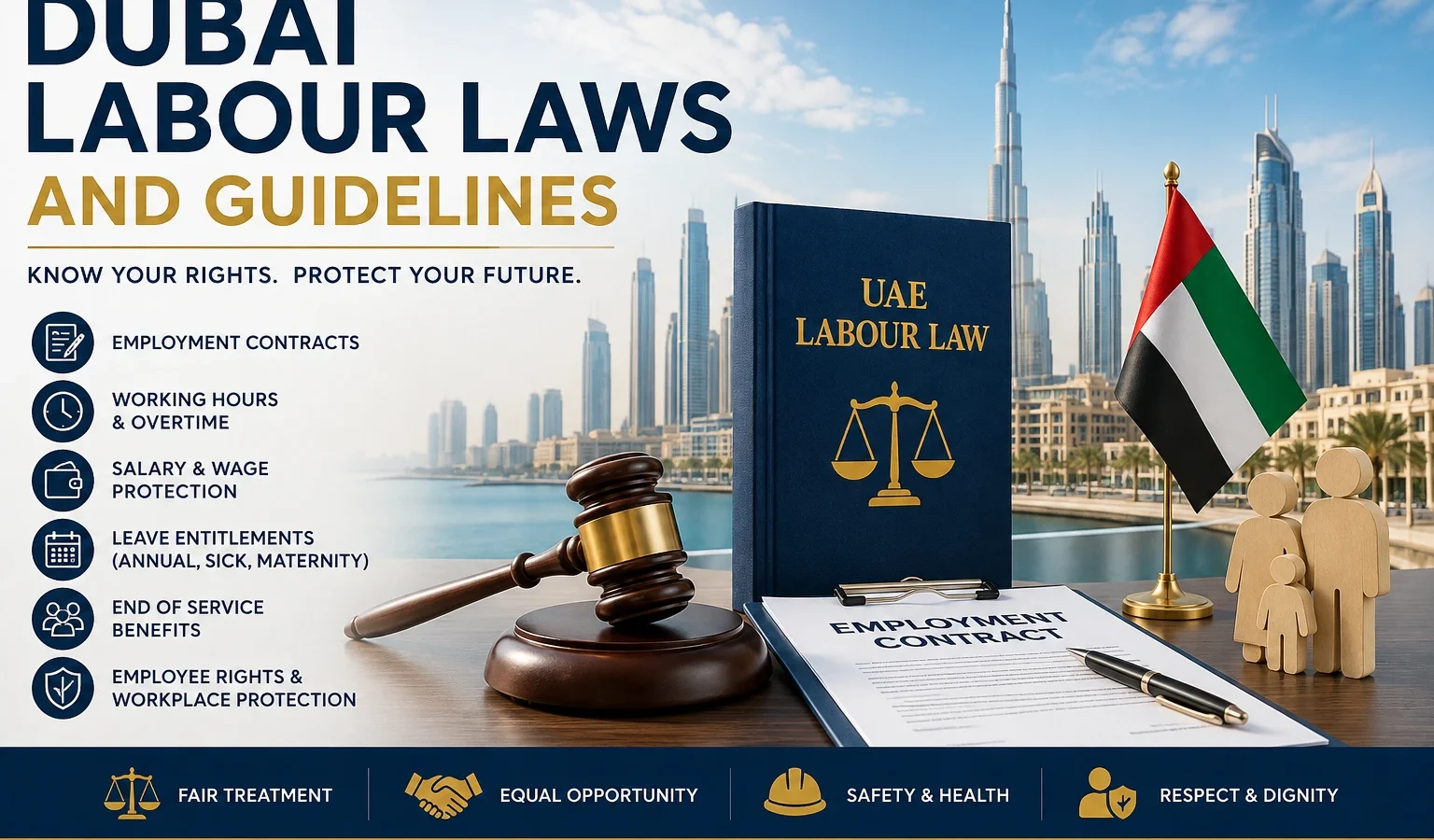
Dubai Labour Laws and Guidelines: A Complete Guide for Employees and Employers
Dubai is one of the world’s leading business and employment destinations, attracting professionals and companies from across the globe. With thousands of businesses operating in the emirate, understanding Dubai labour laws and employment guidelines is important for both employees and employers.
Thank you for reading this post, don't forget to subscribe!For most private-sector employees in Dubai, employment relationships are primarily governed by the UAE’s Federal Decree-Law No. 33 of 2021 Regarding the Regulation of Employment Relationships, along with its amendments and implementing regulations. The law establishes important rules covering employment contracts, working hours, wages, leave, termination, workplace rights and other employment matters. (U.ae)
This guide explains some of the key Dubai labour laws and workplace guidelines in simple language.
1. Employment Contracts in Dubai
Employees working in the UAE private sector generally work under employment contracts that establish the terms and conditions of their employment.
An employment contract should clearly set out important information such as the job role, salary, working arrangements and other agreed employment conditions.
Employees should carefully read their contracts before accepting a job. It is particularly important to check the salary, benefits, probation period, notice requirements, working hours and leave entitlement.
Employers should also ensure that employment documentation complies with applicable UAE labour regulations.
2. Working Hours
Working hours are an important part of UAE employment regulations.
For many private-sector employees, the normal working time is eight hours per day or 48 hours per week, subject to the applicable legal provisions and working arrangements.
Certain sectors, occupations and circumstances can have different rules. Employees may also be entitled to breaks and rest periods according to the applicable regulations.
Because working-hour requirements can vary depending on the nature of employment, employees should check their contract and the latest guidance issued by the Ministry of Human Resources and Emiratisation (MOHRE).
3. Salary and Wage Protection
Employees have the right to receive their agreed wages according to the applicable employment arrangements.
The UAE operates the Wage Protection System (WPS), an electronic system designed to monitor the payment of workers’ wages. MOHRE states that the system helps ensure employees receive wages according to their employment contracts and on time. (مرصد سوق العمل في دولة الإمارات)
If an employee believes their salary has not been paid correctly or on time, they should maintain relevant documents such as their employment contract, payslips and payment records.
4. Annual Leave
Annual leave is an important employee benefit under UAE labour regulations.
Eligible employees are generally entitled to paid annual leave, with the entitlement depending on their period of service and the applicable employment regulations.
Employees should understand how leave is calculated, how it can be carried forward and how unused leave is treated when employment ends.
Employers should maintain accurate leave records and ensure employees receive their statutory entitlements.
5. Sick Leave
Employees who are unable to work because of illness may be entitled to sick leave subject to the conditions and procedures established under UAE labour regulations.
Employees may be required to provide appropriate medical documentation or follow their employer’s procedures for reporting sickness.
The exact entitlement can depend on the employee’s circumstances and length of service, so employees should refer to the applicable law and their employment contract.
6. Maternity and Parental Leave
UAE labour regulations also provide leave protections relating to childbirth and parenting.
Eligible employees can receive maternity leave according to the applicable legal provisions. The law also provides parental leave provisions for employees in qualifying circumstances.
These provisions are intended to support employees while balancing work and family responsibilities.
7. Probation Period
Many companies in Dubai use probation periods when hiring new employees.
Under UAE private-sector employment rules, a probation period cannot generally exceed six months.
Employees should understand the conditions applicable during probation, particularly regarding termination and notice requirements.
It is advisable to read the employment contract carefully before joining a company.
8. Resignation and Notice Period
Employees and employers must follow the applicable contractual and legal requirements when ending an employment relationship.
A notice period may apply when an employee resigns or an employer terminates employment.
Employees should not simply stop attending work without understanding the consequences. Similarly, employers should follow the correct legal process when terminating an employee.
The applicable notice requirements can depend on the circumstances and the employment contract.
9. End-of-Service Benefits
Eligible employees may receive an end-of-service gratuity when their employment ends, subject to the applicable UAE regulations and eligibility requirements.
For employees covered by the traditional gratuity system, calculations generally consider the employee’s basic salary and period of service.
Employees should keep copies of their employment contract, salary records and other relevant documents so that their final settlement can be checked.
10. Workplace Discrimination and Harassment
A professional workplace should provide equal and respectful treatment to employees.
UAE employment regulations prohibit discrimination on specified grounds and provide protections against workplace harassment, bullying and other unacceptable conduct.
Employers should establish appropriate workplace policies and procedures, while employees should report serious workplace concerns through the appropriate channels.
11. Health and Safety at Work
Employers have responsibilities relating to workplace health and safety.
This is particularly important in industries such as construction, manufacturing, logistics, hospitality and other sectors where employees may face occupational risks.
Employers should provide appropriate safety measures, instructions and working conditions according to the applicable regulations.
Employees should also follow workplace safety procedures and report dangerous conditions when necessary.
12. Recruitment and Employment Practices
Employers should follow the applicable UAE rules when recruiting workers.
Job seekers should be cautious about employment scams. A genuine employer should provide clear information about the job, employment terms and relevant documentation.
Job seekers should never hand over important personal documents or make payments to unknown individuals without verifying the employer and recruitment process.
Before accepting a Dubai job, candidates should verify the company’s identity, understand the salary and benefits, and carefully review the employment contract.
13. Working in Dubai Free Zones
Dubai has numerous free zones, and employment arrangements can differ depending on the relevant authority and applicable regulations.
Employees working in a free zone should check which employment rules apply to their particular workplace.
The UAE Government specifically notes that laws applicable to recruitment and employment can vary in free zones. (U.ae)
14. What Employees Should Keep as Records
Employees should maintain copies of important employment documents, including:
- Employment contract
- Salary records
- Payslips or payment evidence
- Leave records
- Resignation or termination correspondence
- Company HR communications
- Work permit and employment-related documents
Keeping these records can be useful if a disagreement arises between an employee and employer.
15. What Employers Should Do
Employers operating in Dubai should aim to maintain proper employment records and comply with applicable UAE labour regulations.
Good HR practices include:
- Providing proper employment documentation
- Paying salaries according to applicable requirements
- Maintaining employee records
- Following working-hour and leave requirements
- Maintaining workplace safety standards
- Applying fair workplace policies
- Following the correct procedures for resignation and termination
- Addressing employee complaints appropriately
16. What To Do If There Is a Labour Dispute
Employees who have a dispute with an employer should first try to resolve the matter through the company’s HR department or management where appropriate.
If the issue cannot be resolved, employees can explore the official labour complaint and dispute-resolution channels available through MOHRE.
Keeping written records and supporting documents can make it easier to explain the issue.
Final Thoughts
Understanding Dubai labour laws and employment guidelines is important for anyone working or hiring in the emirate. From employment contracts and salaries to working hours, annual leave, resignation and end-of-service benefits, knowing your basic rights and responsibilities can help create a healthier workplace.
At the same time, labour regulations can change and certain rules may differ according to the type of employer, free-zone status, occupation or individual circumstances. Employees and employers should therefore check the latest official information before making important employment decisions.
For authoritative information, readers should refer to the UAE Government and MOHRE rather than relying solely on social media posts or unofficial websites. The UAE Government identifies Federal Decree-Law No. 33 of 2021 and its amendments as the principal framework governing private-sector employment relationships. (U.ae)